

In 2003, after one more English winter, Maggie Ann and Enrique Escudero moved to Panama to live off the grid and to share that life with others. They bought land in Bahia Honda from Enrique Stephenson, who had farmed cacao, coconuts, corn and pigs on it for fifty years, and they camped there for months before the first bungalow went up.
La Loma sits on that hillside now, a 55-acre private reserve on Isla Bastimentos above a sheltered bay, next to the Ngäbe-Buglé community that 19 of our team members call home.
Sustainable now appears on almost every hotel website, and there’s nothing standing behind the word itself. Past the photographs, the difference sits in ordinary places, in who works there and for how long, in where dinner was grown, in what keeps the lights on after dark.
At La Loma, those details are the operation, and most of them were in place before there were any guests. Solar panels carry the whole property, the kitchen cooks out of the farm on the hill below it, and the greywater from the showers runs into leach fields planted with water-absorbent plants.
This guide covers what to ask any hotel before you book, what a specific answer sounds like, and what a vague one tends to leave out. It works through the five checks in order, staff tenure, food, energy, water and waste, and the local economy, along with what certification does and doesn’t tell you, the eight questions to send before you pay a deposit, and what happens at La Loma under each one.
Seven open-air bungalows run from a king for two up to a two-bathroom suite in the middle of the cacao farm, each with a private bathroom and a hot shower, and each a short walk from the farm, the trails, and the rock pools.
See the bungalows and check your dates on the accommodation page
What Makes an Eco Lodge Sustainable

An eco lodge is sustainable when the daily operation backs the label, and that shows up in the staffing, the food, the power, the waste, and the money. The term covers accommodation built and run to keep its environmental impact low, usually small, usually remote, and usually tied to the place around it.
Eco lodges, eco-resorts, an eco camp, and any eco-friendly hotel are all sold as eco-friendly accommodation, and none of those labels is regulated, so there’s nothing stopping a property picking one up. Most eco-lodges are owner-run and small. The smallest often have the strongest case, because a little eco-lodge can grow a real share of what it’s serving.
La Loma started that way, and it’s changed hands once. Aaron and Sebastian took over in 2019, closed the lodge to expand the permaculture farm and rebuild the restaurant, and reopened at the end of 2020. The off-grid sustainable living side of it hasn’t changed. The whole story is on our about page.
85% of travelers now say more sustainable travel matters to them. And that means a lot of properties in hospitality have learned the vocabulary. Ecotourism sells, so the word arrives long before the practice does.
Five checks will tell you most of what you need to know about an eco lodge, and you can run every one from your inbox before you’ve paid anything.
| What to check | What a specific answer looks like | How to check it before you book |
| Staff tenure | Names, roles, and years, with the longest-serving people identified | Read the team page, then ask who has been there longest and what they do |
| On-site food | Named ingredients off the property, and honesty about what is bought in | Ask what was grown on site at yesterday’s breakfast |
| Energy sources | On the grid, off-grid, or on a generator, and what heats the water | Ask what the house rules say about high-draw appliances |
| Water and waste | Where greywater goes and how waste leaves a place with no collection | Ask what happens to recycling and whether there is a refill station |
| Local economy | Named organizations, named communities, and dates | Ask which groups they work with and since when |
What Eco Lodge Certification Covers
Eco lodge certification covers audited criteria for things like energy, water, waste, and community impact, and it won’t tell you much about how a property runs day to day. The Global Sustainable Tourism Council sets the baseline criteria most credible schemes build on, and the GSTC framework sits behind much of the accreditation you’ll see. Green Key, Green Globe, and EarthCheck are the programs that come up most often.
LEED works differently. Short for Leadership in Energy and Environmental Design, it covers green building, so a LEED rating tells you about the sustainable construction and the sustainable materials, and very little about the kitchen or the payroll.
But badges can outrun their own standard. In March 2024 the Dutch consumer regulator ACM found that a major booking platform’s sustainability badge was a possibly misleading sustainability claim, and the program came offline worldwide in favor of third-party certification.
Certification costs money and staff time, which a small owner-run lodge often can’t justify. Sustainable hospitality is a small field at this end of the market, and audits are usually priced for hotel groups, so you’ll find real work going uncertified. So an uncertified property with a detailed answer is a better bet than a certified one with a vague answer. Greenwashing survives in the gap between sustainability claims and the audits behind them.
How Long the Staff Have Worked There

Hilda’s cooked here for 19 years and she’s the one who turns our cacao into chocolate. Jana’s been here 15 years as a cook and massage therapist, Fidelina’s run housekeeping for 14, and her sister Maritza for 12. Their portraits and years are on the team page.
Ask any property how long its longest-serving team member has been there. Tenure is easy to ask about. It’s slow to build. The person who carried the coffee up the hill this morning has probably been doing it longer than you’ve had your job, and 19 of our team come from the Bahia Honda Ngäbe-Buglé community around the bay, with others from the island.
Where the Food Comes From

Most of the food at La Loma comes off our own permaculture farm, and a lodge that grows its own can tell you which tree your breakfast came off and then walk you to it. Ask whether there’s an organic farm or a kitchen garden on site, how much of the menu it covers, and where the rest is bought. Farm-to-table dining is the easiest phrase in hospitality to print and one of the harder ones to back.
La Loma’s likely the only hotel on Isla Bastimentos with a working cacao farm on the property. Our permaculture farm feeds the kitchen with fruit, herbs, and vegetables, along with the cacao behind the chocolate dessert and the morning cacao drink.
The cacao here predates the lodge. Permaculture designer Stephen Brooks of Punta Mona helped lay out the expanded farm in 2019 and 2020. It’s built to work like a natural system, with fruit trees, garden beds, and cacao growing in the same shade.
The groves hold thousands of cacao trees, all of them grown free of pesticides and synthetic fertilizers. Pods get cut down and split, the beans ferment, then dry in the sun, then roast, then go through a hand grinder. That whole run from pod to bar happens on the property. You can watch it in a morning.
Your rate covers three meals a day, along with coffee, tea, fresh juices, and cacao drinks. Dinner is three courses, family style, built around whatever the farm’s giving that week. And what isn’t growing here gets bought in Bocas. That’s the honest half of any locally sourced claim.
How an Eco Lodge Powers Itself

Energy is the check with the clearest answer at any property, because a place either generates its own power or it buys it. At La Loma we generate ours, 100% off-grid on solar. Renewable energy sources cut a lodge’s reliance on fossil fuels, and going fully off-grid cuts it completely, which is the biggest single lever a remote property has on its carbon footprint.
You’ll meet that fact in our house rules well before you meet it on a sustainability page. Solar panels carry the whole property. Your bungalow runs on them, with LED lighting, a ceiling fan, 110V outlets, and hot water.
So we ask guests to charge laptops and camera batteries during the day, while the panels are working hardest. Hair dryers and straighteners stay at home.
Cooling comes from the canopy overhead and a fan in every room, and that’s what the open-air design is for. Air conditioning is the heaviest draw in a hotel’s energy consumption, and a building designed without it has solved the problem at the source. And WiFi lives at the dining pavilion, running on Starlink, so it’ll go patchy in heavy weather (a feature, according to roughly half our guests). The rest of the practical detail sits on the lodge FAQs page.
When you ask another property, ask whether a generator runs as backup and how often. A diesel unit humming most nights changes the emission picture completely, whatever the solar array out front suggests.
Recycling, Water, and Waste
Water and waste are where a lot of eco claims go quiet, and they’re worth pushing on. Find out what happens to greywater from the showers and the kitchen, whether there’s rainwater harvesting, and how waste management works somewhere with no municipal collection. On an island, that last one matters most.
La Loma’s water is rain-caught and filtered through a three-stage system, with a natural spring held in reserve. You refill your bottle from it. And it’s the same water in the showers.
Greywater from the showers and the kitchen runs into septic systems with leach fields, where it’s filtered through water-absorbent plants.
Recycling in a remote destination usually means sorting material and hauling it back to the mainland by boat, at the property’s own cost. So a lodge that recycles should be able to tell you where the material ends up, and one that can’t may be sorting it into the same pile at the other end.
Here, cans go to locals who sell them for aluminum scrap, and glass goes by boat to the recycling center on Isla Colón, where it’s crushed. Plastic is the hard one. It doesn’t really get recycled in Bocas, so cutting it out at the start matters more.
Look for a refill station, low-flow fixtures in the bathrooms, and a property that has cut single-use plastic. Towel and linen reuse cards are the most visible of all sustainable practices in hospitality and among the least meaningful on their own. Water conservation shows up in the plumbing, not on the card by the sink.
How to See an Eco Lodge’s Farm for Yourself

You can walk the farm at La Loma on the Cacao and Permaculture Farm Tour, included with every stay, and a property that’s farming should be able to offer you the same. The tour starts at 10:30 in the morning and runs about two hours.
You’ll walk the groves, taste the white pulp straight out of a fresh pod, and watch the fermenting, drying, roasting, and grinding. Lunch follows at one, made from the farm. Keep your eyes up on the way through, because white-faced capuchins and Panamanian night monkeys feed on the cacao pods, and hummingbirds work the flowers along the path.
La Loma sits on one of the higher hills in Bocas del Toro at just under 70 meters, and getting between the bungalows and the restaurant means steps and steep walks. The minimum age on the property is 8 years old.
The trails, the natural rock pools, kayaks, and binoculars come with every stay too. There’s yoga at 8am most mornings in an open-air pavilion facing straight into the tropical rainforest canopy, and the hosted wellness retreats build whole weeks around it.
Read what happens on La Loma’s cacao farm tour
Where Your Money Goes in the Local Economy

Money spent at La Loma goes into wages in the Bahia Honda community and into two nonprofits that have worked there since 2011. Conservation and community are where a lodge can make a positive impact beyond its own fence line, and both leave a trail you can follow. Ask any property which local communities it works with, what conservation efforts it funds, and since when. Vague answers tell you plenty.
Bahia Honda is the bay the lodge sits above, home to roughly 30 Ngäbe-Buglé families and close to 200 people, with a primary school of about 50 students at its center. Both organizations behind our community work started with people who had been here.
Give and Surf was started by a former La Loma volunteer and has worked in Bocas del Toro since 2011. It runs education and community development programs in Bahia Honda and Bahia Roja, shaped with the local families, students, and teachers who live there.
Employing local people is the quieter half of the same thing, and it’s the part that keeps working after the donation runs out. Guests with room in a bag also give back through Pack for a Purpose. The school’s list runs to pencils, soccer balls, and books in Spanish.
Questions to Ask Before Staying at an Eco Lodge
You can fit these eight questions in one email, and they’ll tell you more than any badge. Send them before you pay a deposit. Then pay attention to how specific the reply is.
- How long has your longest-serving team member worked here, and what do they do?
- Which parts of yesterday’s meals came off your own land, and what did you buy in?
- Are you on the grid, off-grid, or running a generator, and what heats the water?
- What happens to your greywater, and where does recycling go from here?
- Can guests walk the farm or garden with someone who works it?
- Which community organizations do you work with, and since when?
- What’s included in the rate, and what gets charged separately?
- What should I leave at home?
Eco-Friendly Practices for Your Stay
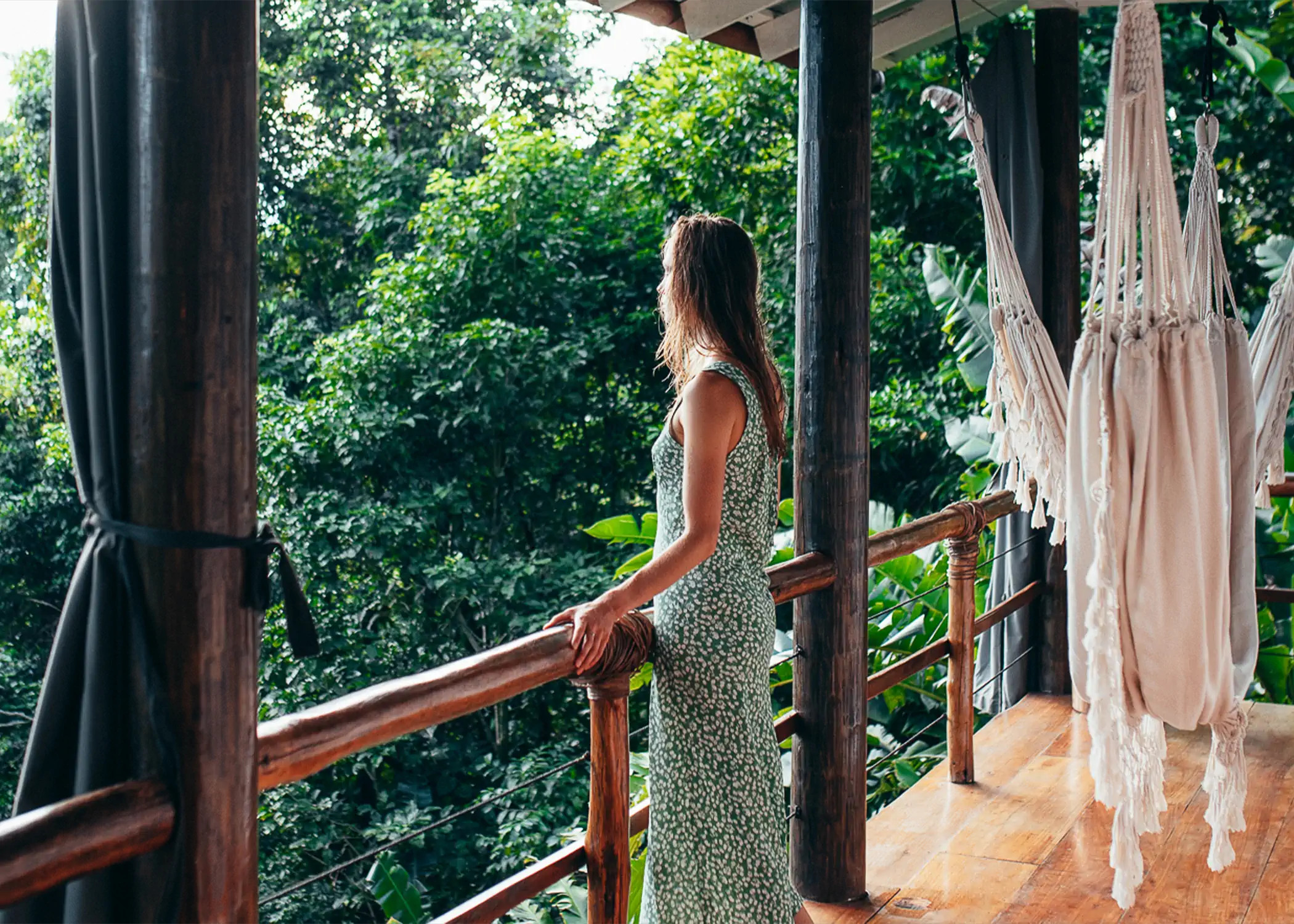
Your part, once you arrive, is small. Responsible travel here comes down to a few habits, and none of them is difficult. Stick to marked trails on nature walks, since the paths through habitat get wider every time somebody steps around a puddle. Refill your bottle at the station, since you’re on an island. Reuse the towel, because the water here is rain-caught and the supply is finite.
Book the excursions run by the property or by local operators, eat what the kitchen is growing, and support local makers by buying from people who live where you’re standing. That’s most of what responsible tourism amounts to in practice, and eco-friendly travel is rarely more complicated than that.
Stay at a sustainable eco lodge in Bocas del Toro, book directly with La Loma Jungle Lodge
Frequently Asked Questions
How Can You Tell If an Eco Lodge Is Sustainable?
A sustainable eco lodge answers with specifics, naming long-serving local staff, food grown on the property, the energy sources behind the lights, where waste goes, and community partnerships with dates attached. Ask for all five before you book, and you’ll know quickly. A property that’s doing the work will answer in a paragraph, and greenwashing tends to answer in a slogan.
What Is the Difference Between an Eco Lodge, an Eco-Hotel, and an Eco-Resort?
Eco lodges are usually small and remote, built into a natural setting with a low-impact footprint. Eco-resorts tend to be larger and offer more amenities, and an eco-friendly hotel is often a conventional hotel with sustainability practices layered on. None of the three terms is regulated, so the same checks apply to all of them.
Does Eco Lodge Certification Guarantee Sustainability?
Eco lodge certification narrows the field without settling it. Schemes such as Green Key, Green Globe, and EarthCheck audit against published criteria, and the Global Sustainable Tourism Council sets much of the underlying framework. Small owner-run lodges often skip certification on cost alone, so an uncertified property with detailed answers can be doing more than a certified one.
Is La Loma All-Inclusive?
La Loma’s rate covers three meals a day, the round-trip private boat transfer from Bocas Town, the cacao and permaculture farm tour, and access to the trails, rock pools, kayaks, and binoculars. You dine family style at a three-course dinner built from the farm. Alcohol, guided excursions, massages, and taxes are charged separately, and you’ll book the excursions you want as you go.
How Do You Get to an Eco Lodge on Isla Bastimentos?
You fly from Albrook Airport in Panama City to Bocas del Toro on Air Panama or FlyTrip, both of them daily, and you book direct on their own sites. La Loma’s private boat leaves Bocas Docks at 4pm, and the ride to our dock takes 15 to 20 minutes on water that stays sheltered behind the islands. Full detail sits on the getting here page, and our Panama City to Bocas del Toro guide walks the whole route.
What Is the Weather Like in Bocas del Toro?
Bocas del Toro doesn’t really have a dry season. The archipelago is tropical year-round, with warm days and some rain in every month, which is what keeps the rainforest as green as it is. Pack a light rain layer whenever you come.
What Wildlife Will I See at an Eco Lodge in Bocas del Toro?
Both two-toed and three-toed sloths live in the trees here, along with white-faced capuchins, Panamanian night monkeys, strawberry poison dart frogs, and hummingbirds. Out on the water you may see bottlenose dolphins, and angelfish, wrasses, and groupers over the coral reef. Wildlife moves on its own schedule, so there’s no guarantee on any given morning. Our full guide to wildlife in Bocas del Toro covers where each animal turns up.
What Is There to Do at an Eco Lodge on Isla Bastimentos?
Kayaking the mangrove channels and the hiking trails on the property come with your stay, as do the natural rock pools. Paid excursions include a snorkel trip over the coral reef, the bat cave, a wildlife boat ride, birding, a hike to Long Beach, and the bioluminescence tour on moonless nights. Red Frog Beach is a short boat ride from our dock. You don’t need to book any of it before you arrive.
Is There WiFi at La Loma?
WiFi runs at the dining pavilion on a Starlink connection, and it doesn’t reach the bungalows. Most guests decide that’s the point of coming. Local calls can go through our reception phone if you need one.


